

Integration of Collaborative and Maker Spaces
Introduction
Collaborative Space
Collaboration in education is important, as it allows learners to be introduced to many sources of knowledge. So, the integration of collaborative spaces in your classroom can significantly help in eliciting collaboration between your learners in order for their learning process to lead to better and richer learning outcomes.
Collaborative Spaces are spaces that exist to allow individuals to work together by sharing, communicating, and problem-solving. These spaces typically include open floor plans, moveable furniture, writable surfaces, and large tabletops to accommodate various types of activities. Use cases include class projects, robotic, and electronics, engineering, entrepreneurial endeavors, and more.
This video from Edutopia explores and narrates the concept of collaborative spaces.
Maker Space
We make use of problem-solving skills in all aspects of life (work, home, school,etc.), and as educators, we know the importance of developing problem-solving skills in learners. One great way to develop problem-solving skills is to create! Creating allows one to become a better problem solver. According to Preddy (2013), a maker space is a community destination where students— sometimes alongside staff, parents, and mentors— can create, problem solve, and develop skills, talents, thinking, and mental rigor. Maker Spaces are spaces that allow individuals to work independently or collaboratively with both physical and digital tools to create or fabricate something new. Use cases include robotics, video and photo production, woodworking, sewing, and more.
This video from Eastern Carver County School gives a visualization and illustration of the concept of maker spaces.
Where does Collaborative & Maker Spaces Exist?
Collaborative and Maker spaces can exist in both the physical and digital (i.e. online and in virtual worlds) environments. Many can be located in public libraries, school libraries, dedicated rooms in an office at a company, or online in virtual spaces like Minecraft or open online communities like Reddit.
Why do these spaces work?
Collaborative & Maker spaces significantly help in facilitating learning because they are rooted in the fact that the process of learning is a social, cognitive, and constructive act. Collaborative & Maker spaces:
bring about creativity
allows for the construction of knowledge
links learners complementary strengths; &
allows for the meaning of knowledge to be shared.

Learning Theories Associated with Collaborative & Maker Spaces

Instructionism vs Constructionism
“Traditional education codifies what it thinks citizens need to know and sets out to feed children this "fish." Constructionism is built on the assumption that children will do best by finding ("fishing") for themselves the specific knowledge they need; organized or informal education can help most by making sure they are supported morally, psychologically, materially, and intellectually in their efforts.” ~Seymour Papert (1993)
Traditional classrooms take the form of “Instructionism” or Behavioristic learning which idolizes that “proper” learning can only take place inside schools where an expert (the teacher) instructs and transfers knowledge to the learner. Instructionist and behaviorist learning is learning that occurs in a linear manner. Ivan Illich (1971) stated that “Education is suffering from narration sickness”, which illustrates that our current school systems have idolized that we can only become knowledgeable about something if we go through the mode of narrated teaching and learning. In instructionism, the teacher is at the center of the learning process. Many educators and research experts have emphasized greatly on how traditional education and classrooms are not effective in facilitating learning and acquiring true knowledge. This is where the Constructionist Learning Theory comes in!
Constructionist learning comes about when the learner and the teachers take different roles in the process of learning. In Constructionism, the learner is at the center of the learning process, and the learner is navigating their own learning based on their individual experiences. While the role of the teachers is to facilitate discussions and provide appropriate scaffolding for the learner throughout the learning process. Papert’s constructionist learning theory focuses on the idea that instructors should adopt teaching techniques that allow the learner to construct their knowledge. This form of learning switches the traditional roles of teaching and puts the learner in the center. Constructionism allows for :
Collaboration
Creativity
Student engagement
Application of knowledge and thinking skills (from the learners)
Critical thinking
Having explored instructionism and constructionism, it is important to note the learning theory that associates with the integration of collaborative and maker spaces into classroom settings in constructionism. Collaborative and Maker spaces align with constructionism because of the spaces:
Brings about creativity in learners
Allows for the construction of knowledge
Links learners complementary strengths; &
It allows for the meaning of knowledge to be shared.

Connected Learning
Connected learning is a form of learning where the learner has an opportunity to pursue a personal interest or passion with peers and mentors so that learning in their project is linked to academic growth, a broadened career, or other. The connected learning model posits that learners will learn best when they are interested in what they are learning, that they have peers and mentors who share these same interests, and their learning is directed toward opportunities and recognition.
Connected learning encourages us to think beyond our traditional and formal ways of learning. In Hanging Out, Messing Around, Geeking Out by M. Ito et. al, as youth climb between various interactive zones of learning, building on top of their prior knowledge, you see their immersion into these spaces with their peers as they help each other to learn together. The authors help establish these categories by adopting language that the kids use, and in doing so signify that they are taking the kids’ experiences seriously.
“Hanging out,” “messing around,” and “geeking out” describe differing levels of investments in new media activities in a way that integrates an understanding of technical, social, and cultural patterns. It is clear that different youth at different times possess varying levels of technology- and media-related expertise, interest, and motivation. The genres of participation that emerged from our research can be viewed as an alternative to existing taxonomies of media engagement that generally are structured by the type of media platform, frequency of media use, or structural categories such as gender, age, or socioeconomic status.”
Additionally, motivation is a key element in the success of connected learning. Learners are already exploring categories that interest them outside of school. Seen in The Children’s Machine, by Papert, “school strikes many young people as slow, boring, and frankly out of touch.” In new spaces within libraries, we see an evolution of understanding who learners are and how they are learning. We find sources of motivation for learners. Mark Bilandzic share in Connected learning in the library as a product of hacking, making, social diversity and messiness, “The purpose behind such Commons 2.0 spaces is to better facilitate open sharing, collaboration and human interaction in general, thus fostering the learning principles of social constructivism (cf. Vygotsky, 1978; Wertsch, 1997). Such library spaces foster the evolution of the library role away from being a “gatekeeper” of books, more and more towards being a facilitator for learning and knowledge. Learning and the acquisition of knowledge are recognized as a social phenomenon which – according to the principles of social constructivism (Vygotsky, 1978; Wertsch, 1997) – is created through social interaction, conversation, and collaboration.
Some of the new spaces inside of many libraries are Collaborative and Maker Spaces. These interactive and incubative spaces offer a hands-on, hacker, and tinkerer learning approach to problem-solving and invention. Rebekah Willett in, Making, Makers, and Makerspaces: A Discourse Analysis of Professional Journal Articles and Blog Posts about Makerspaces in Public Libraries, explores these spaces noting the following.
“Drawing on constructionist models of learning, instruction in makerspaces is described in the articles as “facilitating” and “mentoring” rather than teaching; learners are seen to be “doing” rather than receiving knowledge, and learning is based on a “demand for knowledge” rather than a supply of knowledge. Makerspace learning activities are described as more hands-on, active, and participatory than “rote learning.”
Mark Bilandzic again notes that “Public libraries are an example for learning spaces that are deliberately curated to support free-choice learning. Learning is a social process; people, whom we encounter or interact within our everyday lives, shape our awareness and exposure to different ideas, interests, activities, hobbies, and themes. In particular, through interaction with other, more knowledgeable people, we learn things that we would not be easily able to grasp on our own (Vygotsky, 1978)”

4Cs: Create, Communicate, Cogitate, & Connect
This section contains information about and resources for integrating collaborative and maker spaces into a classroom setting, to enhance the learning experiences of students. We have explored and provided supporting scholarly articles that illustrate and investigate popular learning theories. Consequently, the knowledge gained from our exploration is what is used to ground and validate our project in terms of providing resources and information that showcases the importance and effectiveness of integrating collaborative and maker spaces into classroom settings.
Preddy (2013) stated that “the four key components to an inquiry, lifelong learning, and the American Association of School Librarians (AASL) Standards for the 21st-Century Learner are thought to, create, share, and grow. Examine these four words, simple yet complex learning and thinking concepts. They are integral to the newest advancement in school libraries and school librarianship”.
With this in mind, we developed the 4Cs for exploring and illustrating collaborative and maker spaces. These 4Cs are for students to Create, Communicate, Cogitate, and Connect. This section prompts an instructor to ask why they want to integrate a collaborative and/or maker space into their classroom. Based on their choice, we have provided information and supporting scenarios that demonstrate how and why to integrate collaborative and maker spaces to match the instructor’s chosen “C”.
4Cs Scenarios
Question: Why do you want to integrate a collaborative space in your classroom?
Answer: I want my students to …
CREATE
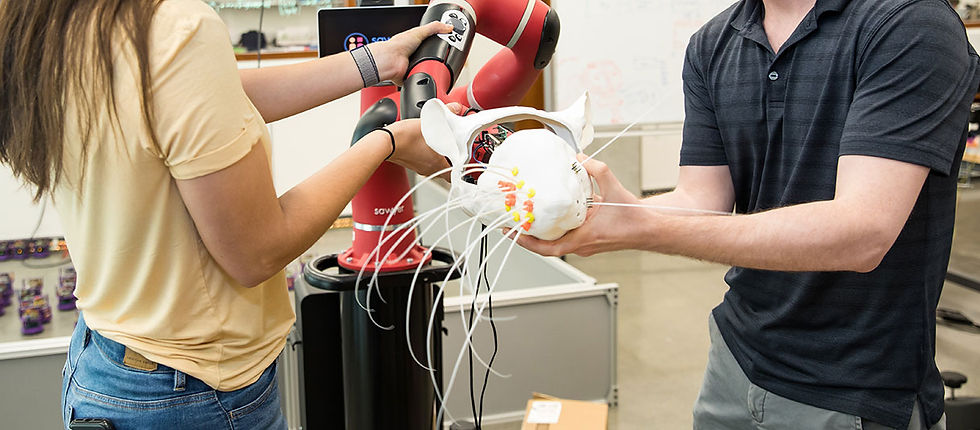
The art of creating is a form of expression, and the process of creating allows one to cultivate problem-solving skills. It is important that learners are able to express themselves adequately while they are in the process of learning. It is also important for learners to develop problem-solving skills, as it enables them to efficiently navigate through problems. Therefore, it is vital that learners are given the space and opportunity to create. Some classes that will benefit from spaces intended to elicit creativity and creations are :
Robotics: This video explores the Robotics maker space at the University of South Florida Collaboratory.
Engineering: This video explores the engineering Marker Space at the University of Wisconsin.
Digital Design: This video explores the online Digital Design Maker Space by Paisley YMCA.
3D Printing: This video explores the 3-D printing Maker Space by Ultimaker.

COMMUNICATE
Foundational to society is our ability to communicate with others. So, it is important to be able to establish effective communicative dialogue amongst students. As an instructor, you can create and design a collaborative space to establish a dialogue between students to allow these students to explore and understand each other's viewpoints constructively. Two effective ways to create spaces that bring about communication between students are through establishing:
Dialogue Circles: According to Edutopia (2014), Dialogue Circles are “gatherings in which all participants sit in a circle facing each other to facilitate open, direct communication.”
Watch this video from eduExcellence, on how to create this collaborative dialogue circle in your classroom, and why dialogue circles are effective in classrooms.
Teamwork Projects: This allows and encourages constructive learning, as well as, allows students to establish a communication dialogue. In teamwork projects, students are to work with a collective unit towards a common goal, which almost always requires the students to communicate with one another. Teamwork projects allow for collaborative learning, and so by creating a collaborative space where students can work together, will build these students’ overall communication skills in and out of the classroom.
Watch this video to see how to integrate collaborative teamwork projects spaces into classroom settings.

COGITATE
“Traditional education codifies what it thinks citizens need to know and sets out to feed children this "fish." Constructionism is built on the assumption that children will do best by finding ("fishing") for themselves the specific knowledge they need; organized or informal education can help most by making sure they are supported morally, psychologically, materially, and intellectually in their efforts” ~ Seymour Papert (1993)
According to Papert, traditional education that takes the form of instructionism idolizes that “proper” learning can only take place in schools where an expert instructs the learner on how to gain knowledge, strictly in the walls of the classroom. Papert explored the need for regulating the learning techniques we use in schools. He suggested that the learner and the teachers take different roles—by removing the teacher from the center of the learning process and placing the learner in the center instead. This way the learner is navigating their learning based on their individual experience but still has teachers there providing appropriate scaffolding for the learner through the learning process.
To cogitate essentially means to think deeply. There are certain classes that require learners to cogitate to elicit a richer understanding of a particular phenomenon. If the goal is for the learner to constructively learn, then we must remove the instructor from the center of learning, as well as encourage a high degree of collaborative learning. Therefore, having a space that allows and encourages the learner to think deeply and collaboratively could be beneficial for the learner’s overall success in this class. Examples of a class that may require students to cogitate are:
Philosophy or Literature: In this type of class, learners are exploring the fundamental nature of knowledge, reality, and existence. Therefore, a collaborative space can be beneficial, as it will create a space for learners to think deeply and collaboratively with their peers. The goal of thIS type of classroom is to bring about constructive learning by changing the dynamic of the classroom. In other words, we want the learners to construct the meaning of knowledge. One way to achieve this goal is by changing the way the classroom looks.
Explore this video to see how you can transform a traditional classroom into a more constructive classroom that allows learners to cogitate and collaborate.

CONNECT
“Young people can have diverse pathways into connected learning. Schools, homes, after school clubs, religious institutions, and community centers and the parents, teachers, friends, mentors and coaches that young people find at these diverse locales, all potentially have a role to play in guiding young people to connected learning” ~ (Ito et al, 2013)
Ito et al recognize that learning takes place everywhere and anywhere. They recognize that there are various resources, which take different forms, that help in the facilitation of learning and in the acquisition of knowledge. Ito et al here are saying that even the teachers, parents, the community, peers, etc have their own role that they play in the learning process, acquisition of knowledge, and the formation of meaning. Connected learning is saying that we legitimize all the ways we learn and who we learn from, as it all contributes to our overall experience and how we make meaning of the things we learn.
Knowledge gained outside of a structured school is usually considered informal learning, but this does not mean the knowledge is not just as valuable and true. Informal learning is overall considered as learning that takes place outside of a structured formal classroom environment. Creating a collaborative connected learning environment is creating a space that integrates informal learning and formal learning in ways that allows learners to connect with one another in a world of the constant flux of information.
Ito et. al (2013) illustrated the importance of informal learning, taking place with one's interest groups. Interest-Driven Participation is when the youth is participating in ways that involve them collaborating and engaging with other people who have similar interests as them (Ito et al, 2009). They illustrated that an efficient way to effectively incorporate informal learning into a classroom is by locating the learner’s interest groups and then matching the learner with their interest groups. Collaborating with people, outside of one’s structured learning environment, and who have similar interests, allows one to have a richer learning experience. This can then be advantageous to one’s "structured" learning environment. To ensure connected and collaborative learning takes place, it is important that the instructor is able to map out the learner’s interest groups and create spaces where they can engage with other students that have similar interests. Watch this video to see how Connected Learning helps to make your material relevant to your students.
This then begs the question of how do we legitimize learning in an "unstructured" environment, or how can we learn in schools in ways that incorporate interest groups in our learning spaces? Watch this video to see how this can be achieved in a classroom.
Also the concept of career connected learning is important here. Choosing a career can be a very daunting process. With the way our current education system is set up, very few students are exposed or given the opportunity to explore different career paths. “A career connected learning allows students:
Become an apprentice
Job shadow
Engage in an experiential learning
Explore mentorships
Viewing learning has a social action, Career Connected Learning allows businesses to meet their workforce needs and allows learners to be prepared for great careers. Watch this video that explores more on Career Connected Learning.
Establishing Collaborative & Maker Spaces
Here are the top 2 foundational processes for establishing collaborative and maker spaces.
Picking an Area
Selecting the appropriate area you want your learners to use for creating and collaborating is vital to the process of facilitating learning. The area has to be suitable for collaboration either for an individual learner or multiple learners. Additionally, if it is a makerspace, the area should encourage creativity in the learner. According to Geser and his colleagues (2019), makerspaces are creative environments set up by local communities, school, after school clubs, libraries, museums, and other public or civil society organizations”. So explore any one of these environments and decide on a place to use appropriate for bringing out the creativity in your learners. This website compiles lists of maker spaces around the United States.

Deciding on Supplies
Based on the class you are teaching, gather the supplies that you believe are essential for what the learners are supposed to create.
This website brings together samples of materials you may need for designing a maker space for your students.
This website takes a look at the best collaborative tools for learning.

Equity and Equality
“Connected learning centers on an equity agenda of deploying new media to reach and enable youth who otherwise lack access to opportunity. It is not simply a “technique” for improving individual educational outcomes, but rather seeks to build communities and collective capacities for learning and opportunity like those Clarissa found in her online group.”~(Ito et al 2013)
The use of the term "equity" here is important. Another word similar to equity is equality. Both equity and equality are used to determine fairness, but we choose which one to go with based on our paradigms. Equity is giving everyone what they need to be successful, while equality is treating everyone the same. Ito et al's use of the term equity instead of equality shows their paradigms, in terms of illustrating what is fair. Ito et al are saying that successful connected learning surrounds giving every learner the tools they need to be successful in their community. Also, connected learning is not just centered around the individual's acquiring skills for themselves, rather it also involves the learner having learning opportunities and experiences that elicit social actions.
This video briefly highlights the discussion around breaking patterns and not repeating the past.
In an article by Edutopia they share that “when a makerspace aligns its activities with the principles of creating a participatory culture, it can effectively meet all of our learners' needs. Most useful to consider is the idea of having a low barrier to artistic expression and civic engagement. This low barrier of entry into the makerspace activities will ensure that any of your students -- regardless of their academic proficiency level or even whether English is their primary language -- can begin making with very little or no teacher facilitation.”
An additional area of consideration in these spaces is for those students with disabilities. Are they able to equally participate and learn with similar outcomes as their peers? Are the systems in place excluding them from similar inspirational activities? In a different article, Edutopia highlights that when it comes to the STEM (science, technology, engineering, and math) fields “Individuals with disAbilities are not entering these fields —less than 10 percent of those who have a disability diagnosed early in life and only slightly more than 15 percent of those diagnosed in their high school years enter these fields.”
For more information, you can read a write up over on the Quality Matters page.
Badges
While not unique to collaborative or maker spaces, badges, specifically digital badges, have become a source of pride for both children and adults. When issued upon a demonstration of mastery, and not for participation, they can hold extra weight and act as a source of motivation. Preddy notes, “It is human nature to feel intrinsically good about successes. There is a sense of self-satisfaction in fulfilling a task and seeing the accomplishment of a final product.”
We also find support from Carey and Stefaniak, “Research points to intrinsic motivation being more effective than extrinsic motivation with the former type being attributed to increased learning gains (Abramovich and Wardrip 2016; Randall et al. 2013). One activity known to increase intrinsic motivation is setting and completing goals, as indicated by achievement goal theory (Elliot 1999). Learners who actively participate in their own learning experience increased levels of motivation, according to Goligoski (2012).” Badging in these environments is easily supported across the dynamic range of activities. A self-motivated learner is able to chart a course to get a badge in each category or get second and third-level experience badges within a single category of interest. Badges can be worn with pride in their experience and knowledge as well as their ability to act as a mentor to peers.
You can find out more at:

Sources and Citations
Edutopia. (2014, July 2). Dialogue Circles and Positive Classroom Culture. Retrieved from https://www.edutopia.org/practice/stw-glenview-practice-dialogue-circles-video
Future Ready Schools. (2020, April 23). Future Ready. Retrieved from https://futureready.org/an-equity-approach-to-creating-future-ready-schools/
Geser, G., Hollauf, E.-M., Hornung-Prähauser, V., Schön, S., & Vloet, F. (2019). Makerspaces as Social Innovation and Entrepreneurship Learning Environments: The DOIT Learning Program. Discourse and Communication for Sustainable Education, 10(2), 60–71. doi: 10.2478/dcse-2019-0018
Illich, I. (1971). Deschooling society (1st Harper Colophon ed.). Harper & Row. https://learn.media.mit.edu/lcl/resources/readings/deschooling-ch6.pdf>
Ito et. a (2013)l, Connected Learning: An Agenda for Research and Design [PDF file]. Retrieved from https://dmlhub.net/wp-content/uploads/files/Connected_Learning_report.pdf
Ito et. al, Hanging Out, Messing Around, Geeking Out (2009) [PDF file]. Retrieved from https://clalliance.org/wp-content/uploads/files/Hanging_Out.pdf
Preddy, L. (2013). School library makerspaces: grades 6-12. Santa Barbara, CA: Libraries Unlimited, An Imprint of ABC-CLIO, LLC. Retrieved from:
http://ebookcentral.proquest.com/lib/usf/detail.action?docID=1682944
Papert, S. (1993). The children’s machine: rethinking school in the age of the computer. BasicBooks. < https://ia800909.us.archive.org/23/items/pdfy-WeLwkqLL6w830OqF/Papert%20Seymour-The%20Children%27s%20Machine.pdf>
Laura Fleming & Billy Krakower, Makerspaces and Equal Access to Learning, Edutopia (2016, July 19) Retrieved from https://www.edutopia.org/blog/makerspaces-equal-access-to-learning-laura-fleming-billy-krakower
Johanna Prince & Kevin Good, Making Makerspaces Work for All Students, Edutopia (2018, September 14) Retrieved from https://www.edutopia.org/article/making-makerspaces-work-all-students
Carey, K. L., & Stefaniak, J. E. (2018). An exploration of the utility of digital badging in higher education settings. Educational Technology Research and Development, 66(5), 1211–1229. doi: 10.1007/s11423-018-9602-1
Bilandzic, M. (2013). Connected learning in the library as a product of hacking, making, social diversity and messiness. Interactive Learning Environments, 24(1), 158–177. doi: 10.1080/10494820.2013.825811
Willett, R. (2016). Making, Makers, and Makerspaces: A Discourse Analysis of Professional Journal Articles and Blog Posts about Makerspaces in Public Libraries. The Library Quarterly, 86(3), 313–329. doi: 10.1086/686676