
Transitioning to Distance Learning During a Pandemic

UNESCO estimates that at least 300 million students around the world are not permitted to go to school due to the widespread infection of COVID 19. In turn, educators and administrators in schools and universities all around the world scramble to rethink the best practices for facilitating learning and how it can be achieved remotely.
However, when it comes to these sudden school closures, this situation is not really a new issue. In recent years, schools and university campuses around the world have endured sudden and short-term closures due to war or natural disasters such as hurricanes and wildfires; however, according to UNESCO Director General Audry Azoulay, “While temporary school closures as a result of health and other crises are not new unfortunately, the global scale and speed of the current education disruption is unparalleled and, if prolonged, could threaten the right to education.”
If you are an educator or administrator and your school has been impacted by this sudden worldwide closure or if your school has closed suddenly for any other reason, this guide is for you. The goal of this guide is to provide teachers and administrators with the resources they need to shift quickly from a face-to-face learning environment to a virtual one.
What is Emergency Remote Learning?
Before you embark on preparing your course content for this sudden transition, it is important to understand the differences between a face-to-face or blended-classroom and a distance learning environment. You may have heard the words ‘online education,’ ‘virtual education,’ ‘distance education,’ ‘e-learning,’ etc. being used interchangeably to describe any or all virtual learning environments. Although there are differences between the various virtual learning environments, the actual differences are irrelevant in this particular unprecedented situation. For the purpose of this paper, we will group all of the terms above under ‘distance education.’
In a normal setting, an online course is specifically planned to be delivered as a ‘distance education’ course. That means all of the coursework and the means in which it is delivered are all pre-planned and well thought out in advance. But in our current situation, the nature of the transition from a face-to-face environment to a virtual environment was sudden and very little to no planning was possible within a very short window of time. These unprecedented circumstances call for an unprecedented definition as the term ‘distance education’ doesn’t really encompass the reality of this particular situation, so for the purpose of this paper and this particular situation, we will use the term ‘emergency remote teaching’ and define it as the following:
Any learning environment where students and teachers are geographically separated and the curriculum is delivered via technology. In Emergency Remote Planning, there is a transition from a traditional face-to-face course to a virtual learning environment in which learning continues.

Teacher Qualities for Emergency Remote Learning
Intro
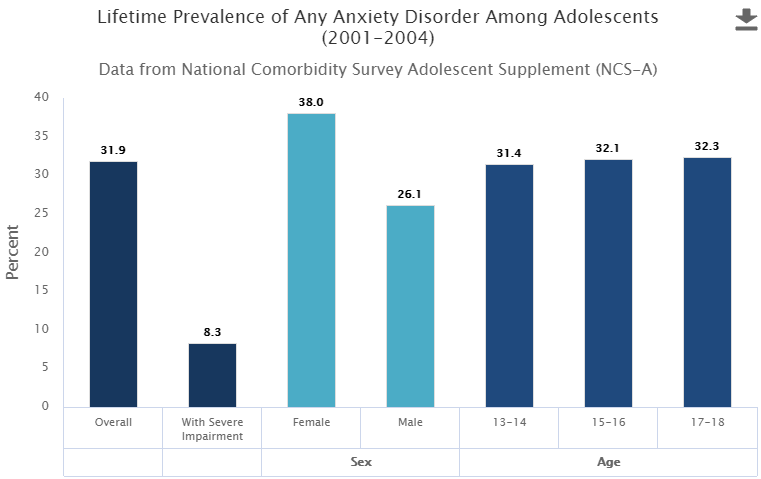
Students in K-12 are becoming more stressed everyday. This is the case for all ages, however, a study conducted by the National Institute of Mental Health (NIMH), based on on diagnostic interview data from National Comorbidity Survey Adolescent Supplement (NCS-A) suggests that just under a 1/3 of teenagers (ages 13-18) have some degree of an anxiety disorder. Figure 1 (NIMH 2017) shows that 31.9% of adolescents had any anxiety disorder, while 8.3% had severe impairment. Now imagine that level of stress in addition to a global pandemic like COVID-19. Throw in other factors associated with the crisis such as social distancing, quarantine/lockdown restrictions, and possible financial hardships like job loss or reduction in hours; it’s simply a recipe for high levels of stress and anxiety for students everywhere. It’s important to take such scenarios into consideration in this new world of education. Many times school provides students with an escape from many of these stressors. With lockdowns and social distancing in place, students are faced with a new reality where they are stuck at home, having to deal with hardships and stressors, with little to no escape from it all. Taking into consideration these factors, the purpose of this section is to outline specific qualities that can hopefully assist any teacher with transitioning to this new emergency remote learning; while at the same time remembering their target audience as the educator.

4 Qualities of an Online Teacher
Be Flexible
Keep in mind that this is a time of increased anxiety for everyone. You may be unaware of other stressors your students are facing in the midst of the pandemic such as parental job loss or reduction in hours. Also remember that not all students have access to the same resources, in both time and technology, to succeed at Emergency Remote Learning. Visit the link for Student Centered Planning to learn more.
Be Passionate
Teachers must remain passionate about teaching during this difficult transition to Emergency Remote Learning. A passionate will have an easier time adjusting to the changes and keeping their students motivated. Look for new ways to motivate students and remember the importance of bringing the social aspect into Emergency Remote Learning. See the following resource on tips for keeping your students motivated during the transition.
Build Good Habits
It is important to provide structure and self-discipline during your virtual school day. Schedule set planning time and office hours in order to take care of administrative tasks and other non-teaching activities related to your students. See the following resource for tips on teaching in an online platform.
Academic Awareness
Remember the various needs of your students. Continue providing differentiated instruction to the best of your ability during Emergency Remote Learning. It's also important to consider technology is a tool for lesson delivery, and not the solution. Visit the following link to learn more about using technology as a resource.
Quality #1
Flexible
As an educator who is transitioning to virtual teaching, remember to have the flexibility for yourself and your students. During times such as a global pandemic (or any crisis that forces the shut down of schools for that matter), there are always circumstances that develop. Remember that school provides students with a separate setting for interaction and learning. When making the switch to online learning, there are many factors that must be taken into consideration.
The teacher must be understanding that each student has unknown situations at home
Recall the amount of stress and anxiety that students face on a regular basis, let alone an extreme situation such as COVID-19. The financial hardships alone can lead to other issues such as inadequate foods, substance abuse, and depression within a family.
Even if there aren't any financial hardships, it doesn’t mean that families don’t have other issues, as well. This could include having to take care of multiple children at home. Or all of those children needing access to technology; while maybe the parent is also working remotely.
To go even further, a parent could be at the front lines as a medical professional. Or even worse, a family may have had to endure the loss of a loved one due to the pandemic. These are all scenarios that are realistic and very possible.
Another huge factor is inequality and inequity among families and students. In L. Cuban's (1994) writing of Public School Teachers Using Machines in the Next Decade, he states that the Office of Technology Assessment found that students from "high-income families have far more access to computers" compared to those who come from lower-income families.” Students who come from families and backgrounds with social and economic hardships, have disadvantages that other students do not. They must face issues such as having access to technology. And even if they are given access, then they typically lack the proper technological and digital skills needed to make the most of the technology.
*To learn more about this topic, click to go to the “Quality Matters” section of the website.
Regardless of the situation, there will be many cases where you don’t know exactly what students and their families are having to deal with. Then, as educators, we are forcing students who come from these families to learn an entirely new system for online education. In many cases like these, learning might be at the bottom of their priorities unless they have a personal interest in what you are teaching and how you are teaching it. It is important to remember that although the school may not be the first thing on a child’s list of things to do (especially right now), that school is one of the few things that provide them with a sense of normalcy. As the teacher, you must be readily available more often now to help and find new ways to either externally or internally motivate students. This is crucial to help continue their journey of learning during stressful times such as this.
The teacher must switch from teacher-led instruction to student-centered and informal learning
With students no longer physically in school, they do not get the same benefits of having a specifically structured learning environment. Students must learn how to create their own learning space within their home. They must learn to teach themselves the content now that they have limited time with an actual teacher. In addition, there is an absence of community which the teacher facilitates within a classroom. Feelings of isolation are more likely to arise as a result of the loss of peer support in their learning environment. Most students do not see their teachers every day, but only for a short period of time via video chat. The old system of school has currently been suspended, and in the matter of a few weeks, the education system has been revamped, reorganized, and adapted to fit the needs of our current situation. With this in mind, students and families will also have to adapt; and we have to be mindful that this can prove to be very challenging. Having a specified learning space and preferably an allotted time set aside for schoolwork is not always feasible in some households.
The schooling system has gone through a drastic change in response to COVD-19. Even though we haven't gone so far as to realize Illich's version of a "deschooled society, it is safe to say that it is somewhat of a step in that direction. I. Illich (1971) is one of the first people to propose this concept of "deschooling society" and rid of the old schooling system that we've had in place for decades. A feature of a "deschooled society" is that it takes the focus away from WHAT the students learn and turns it onto thinking about the types of resources that students might need to access in order to facilitate their learning. In this case, resources include which applications or web sites will students access in order to further their education. S. Papert (2000) although not as drastic, would agree that our old draconian methods of teaching have changed very little over the course of our history.
There's this stigma within the realm of education that aligns with P. Freire's Banking Concept of Education, where the student simply absorbs and memorizes the content that the teacher is providing them. The transition to Emergency Remote Learning makes the traditional "banking model" of education obsolete, at least for the time being. Due to the limitations of teaching k-12 students and their lack of life experience, teachers will have to take a step back as the main providers of information and rather take the mantle of a facilitator of learning, helping students navigate resources for their education and making connections without the benefit of physical proximity and time.
This old concept of schooling has drastically changed over the course of a few weeks. Students now are at home, outside of school and teachers are away from their students. And even though the teachers are still facilitating and directing what is being taught, they spend much less time with their students. The learner must become more autonomous and adopt this method of informal education where much of the responsibility of learning is placed on themselves. This informal format will be student-centered.
With the growth in popularity of placing more responsibility on the student, there is a large push for student-centered learning practices to be used in and outside of the classroom. According to Jerome Bruner (1960) who emphasizes constructivism, "it takes a very skilled teacher to structure a learning experience so that the learner discovers new knowledge on their own”. Distance learning and online courses help propel such student-centered learning. But the point being is that online education with the use of various technologies can provide a quality education that breaks the mold of traditional teaching methods. We are living in a time where we have access to so many technologies to change the way students are taught, but we must use those technologies in a responsible manner that actually makes a difference. That centers the learning process around the student and gets away from the teacher being the sole master of the classroom that controls everything. Instead, the teacher must be the facilitator that helps point the students in the right direction to maximize their learning potential with the use of new technologies. The teacher must be flexible in this manner.
Quality #2
Passionate
As an online teacher, you must be passionate more than ever about your work. You will be missing the element of physical human interaction, and at times it can seem challenging to be excited about teaching from behind a computer screen. It may appear to be nerve-racking diving into this new world of virtual teaching, but it’s important that you find news ways to keep your students engaged. Remember, that even though your learners may be physically distant from you, it’s still a part of your job to help motivate, facilitate and guide them during this process. It’s one thing to have higher education establishments transition to online teaching. It’s a completely different story having K-12 transition. Students are still growing intellectually and emotionally. It is the teacher’s job to be passionate about their work and show their students that passion. If it’s apparent that you aren’t passionate, how can you expect your students to be passionate about learning themselves? It’s still possible to have students do collaborative work, projects, be creative, and engaged. As the teacher, it’s your job to find ways to implement those things even from your computer.
The teacher must learn news ways to motivate the students
According to S. Papert (2010), students will find ways to learn new things even if the teaching is bad. In addition, the practice of Connected Learning stresses that the first step to educating students is for them to have a personal interest in something that they wish to learn. Students will find ways through digital media to learn on their own by "hanging out, messing around, and geeking out".When it comes down to it, it is the student who decides what he or she really wants to learn. They will decide how much effort they will put forth based on personal interest. So, as the teacher, you must be flexible and find new ways to get the student invested in the curriculum. Think about what they may find interesting, while at the same time still executing the state standards that they are responsible for obtaining.
This inadvertently aligns with other concepts such as John Keller's (2009), ARCS Model of Motivational Design Theories where the instructor must first capture the attention of the learner. The teacher can capture the attention of the learner mainly by two methods. First, perceptual arousal using surprise or uncertainty to gain interest. Second, inquiry arousal using challenging questions or problems to stimulate curiosity. Regardless of the situation, when it comes to learning instructors must find ways to gain the interest of our students if we want them to get the most out of their education.
The teacher must bring the social aspect into their new form of virtual teaching
There are a number of learning theories that suggest students perform better in social settings. In accordance with social learning theory, A. Bandura (1977) states that we learn by observing others, seeing models and examples, within a social context. So, it's important not to lose focus of that and continue to provide examples when it comes to teaching online. Images, audio, tutorials, and other digital media are all helpful with this. In addition, J. Brown suggests that students can learn best with hands-on experiences, a promotion of community and collaborative work supporting theories such as cognitive apprenticeship and the collective social mind. All of these elements reinforce socializing, something that is seriously lacking due to COVID-19. Finding ways to promote those social aspects is key to the learning process for many students and helps to continue that passion for teaching.
This also aligns with some concepts of S. Green who suggests that technology and digital media take away from contact time between teachers and students. This is very true in this case with COVID-19, that contact is reduced to as little as possible, even non-existence for education at this time. Finding ways for "digital contact" time is essential to help exemplify the commitment and passion to teach. Finding ways to continue "digital contact" can be found via methods such as video conferences, phone calls, direct messages with apps like Slack, and email. There is further discussion in the next section that will cover maintaining a community and connection.
Quality #3
Good Habits
According to A. Johnson (2013), one of the best practices when it comes to online teaching is to form good habits. Just as the students must self-discipline themselves and form good habits to be successful, so does the teacher. When it comes to virtual teaching, it’s a two-way street.
Teachers must set aside time for “office hours”
Since you won’t have your normal planning period, you must set aside time for “office hours”. Manage your time wisely and make sure you form a habit of abiding by your office hours on a daily basis. This will allow you time to plan your lessons and grade assignments. If you don’t, you may start to become overwhelmed with the amount of work that piles up. You’ll have a lot of distractions at home (spouse, children, pets), and forming good habits such as time management will help to keep you on track to being efficient and effective. Being able to put time into your lessons will ultimately benefit your students and yourself. Students will likely be more engaged, and you less stressed. In addition, setting that time aside will allow you to provide feedback to your students about their work. Feedback in a timely manner is essential when it comes to online teaching because it helps the students know if they are on the right track.
Teachers must facilitate threaded discussions and provide feedback
Feedback is some of the best ways that students learn. S. Papert believes in a more informal setting for learning such as video games where the learner can get instant feedback. However, with your unique emergency setting situation, even if students don't get instant feedback, it's still equally important. There are plenty of programs out there where you can provide questions with answer keys and it will score assessments instantly for students. Those work great! However, it's equally important that as the teacher that you provide your own personal feedback to work. That also applies to discussions. Facilitating and providing feedback in discussion threads will give the students a sense of commitment and direction from you as the teacher. We will go into course interaction in a later section, considering the importance of it. However, the bottom line, forming good habits is so crucial. Setting aside that time to grade and reflect on students' assignments, that could possibly be some of the greatest lessons they learn.
Potentially in the future as suggested by J. Balkin and J. Sonnevend, digital media and technology may gain more ground, causing teacher-student interaction to become less and less. This COVID-19 pandemic is a situation that is shedding light on the possibilities of remote distance learning for students becoming a norm. Continuing to be engaged with the students within a digital space is even more important. You are losing that face-to-face teacher-student interaction, so you must supplement in other ways. Participating in discussion threads, providing regular feedback, and providing opportunities for students to reach you when they need help such as “virtual office hours” direct messaging apps are all good habits to assist your learners.
Quality #4
Academic Awareness
Just like being in the classroom, students have a number of learning styles. With a digital curriculum and instruction, you as the teacher must remember this. It’s easy to forget when you’re creating your online lessons. If you’re human like everyone else, you’re most likely creating assignments and assessments that can be given to all your students. But think about differentiation. You still need to provide various methods of instruction and differentiate the curriculum to help your students be successful. You must be aware of the learning needs of your students, even if they are miles away from you now.
Teachers must not make technology the solution
You can’t think that just because students have regular access to technology and the internet that they are going to excel. You as the teacher are equally an important tool as the technology itself. In addition, just because you are using new programs and applications, it doesn’t mean that the students are going to be more successful.
C. Sims (2017) in his databite and book Disruptive Fixation: School Reform and the Pitfalls of Techno-Idealism refers to this issue of techno-idealism where people (I would say textbook companies too) believe that that the next big thing in regards to technology is "the game changer" for education or other fields. But this is like a broken record that is repetitive throughout history; and no matter what the new "game-changer" is, it is usually not the case and disappointment is repeated.
N. Selwyn (2017) makes a point that as educators we should learn to master the technology that we already have before moving onto something new. Just because the latest educational technology may appear flashy and game-changing, doesn't mean it's what we as educators need to help the students. And to bring N. Selwyn's point even further, we cannot rely on technology to fix all problems that we have in the educational system. Some problems are even caused by technology itself. For example, as mentioned earlier the digital gap that is expressed by L. Cuban. The digital gap is how high-income families are more tech-savvy than those from lower-income families faced with social and economical hardships.
In a Ted Talk by Mary Jo Madda (2017) where she speaks about USC Hybrid High College Prep. A charter school that utilizes technology so much that the students spend 90% of their time using it, with only 10% of instruction time from the teacher. This failed in its first year. The missing piece was the lack of teachers actually teaching and facilitating the students.
Technology needs to be seen as a tool, not a solution. Even in teaching concepts such as connected learning where the student is encouraged to take interest in technology on their own time as part of the learning process, they aren't alone. M. Ito view on connected learning is technology is combined with interests, supportive relationships, and opportunities. Technology is not the answer necessarily to improving the education system; it was something that could spark interest and help though. It's just one piece to a larger set in hopes of improving the education system and working side-by-side with the education system.
The New Role of Technology in Emergency Remote Teaching

Due to the fast transition to online instruction due to COVID-19, technology went from being a supplemental part of the classroom or learning environment to the main mode of delivery. For many instructors, such a sudden change can be quite overwhelming to say the least.
But never fear, technology is here, right? Technology will save the day... or will it?
According to Neil Selwyn, a distinguished research professor in the Faculty of Education at Monash University that’s not necessarily the case. Western thinking views technology as the pinnacle of scientific achievement and has even been assigned a ‘heroic role.’ So, if you believe that the more technology you incorporate, the better the learning experience will be, you are not alone. Selwyn believes that we may have too much ‘faith’ in technology that we are unable to think otherwise. He argues that
“ Educational technology is an essentially ‘positive project.’ Most people working in this area are driven by an underlying belief that digital technologies are — in some way — capable of improving education. This mindset is evident, for example, in the recent tendency to refer to ‘technology‐enhanced learning’ or before this to ‘computer‐assisted learning’ — descriptions that both leave little doubt over the inherent connection between technology and the improvement of learning and teaching.”
For that reason, our most important piece of advice for instructors transitioning to emergency remote teaching is to go easy on the technology and to keep it simple.
Integrating new technology that teachers, students, and even parents have to learn how to navigate during an already stressful time, is not the best idea. Michael Wesch in his Portal to Media Literacy experiment argues that ‘We can’t assume our students are media literate.’ And that is in a ‘normal situation,’ so in an emergency situation it’s safest to assume that our students are not tech savvy.
So, what should a teacher focus on? Wesch believes in the importance of collaboration over tech. He believes that creating a learning environment where students can collaborate is far more important and rewarding than including the latest technology. The focus of the instructor should be on creating ‘platforms for participation’ and that can be achieved using the simplest and most straightforward of tech tools, and not necessarily the most recent or advanced tools. As Barbara Harrell Carson says, ‘Students learn what they care about, from people they care about and know they care about them.’ So, keep that in mind as you work on transitioning your classroom to an online form.
Keeping your mantra of simplicity in mind, it is helpful to understand the many different possibilities e-learning can afford you and your students.
The authors of the book Learning Online: What Research Tells Us about Whether, When and How, identify 9 general dimensions, each of which has numerous options, which showcase the possibilities of e-learning design.

Practical Course Preparation Tips to Enhance Student Learning
Tip 1: Adjust all major assignments and exams
Tip 2: Map Out Your Course Content for Online Delivery
Tip 3: Add a Module on Digital Literacy and Netiquette
Tip 4: Make sure all instructions are crystal clear
Tip 5: Understand and Develop a plan for Course Interaction
Tip 1
Adjust all major assignments and exams
Adjust all major assignments and exams that may need adjusting. For example, a debate you had planned for your face to face class, may not be the best option in a virtual classroom. Don’t be afraid to modify assignments to make them simpler for students to complete.
Tip 2
Map Out Your Course Content for Online Delivery
In the case of an emergency like COVID-19, you want to transition your content online as fast as possible while also making sure that you have incorporated enough support for your students to succeed. For that reason, we recommend that you use The Rapid Prototype Model to serve as your guide. This Rapid E-Learning Model recommends that you organize your content in the following manner.
Get Attention: At the start of each learning module, grab the attention of your learners by asking a relevant question on the subject to stimulate background knowledge, or present a shocking fact or statement, include an image, video, or important statistic.
List the Objectives: Set the direction for the module. Clarify learning objectives and make them relevant by connecting them with how they are going to benefit the learner.
Present the Content: When adding the content, make sure that you include enough information to give the learners enough opportunities to learn and dive deeper into the content. Include attachments, extra videos, supplementary links to sites that can help scaffold the information presented, etc.
Demonstrate the Content: Use examples to demonstrate the content or to show how the knowledge can be used. This can be achieved by checking comprehension and incorporating case studies, samples, etc.
Summarize Key Information: At the end of every module, make sure you have a summary of the content the student was expected to learn and master.
Action and Support: Clarify how students can get any extra help or support they may need.
Tip 3
Add a Module on Digital Literacy and Netiquette
A shift from face to face to online may constitute a heavier than usual need for the use of technology. (Although we always recommend going for simple tech. See New Role of Technology above.) For that reason, it is important to ensure that the students have the support they need to grasp the use of the new technology. If students haven’t already been exposed to the principles of Digital Media Literacy (DML) & Netiquette, it is worth taking some time to review such things whenever interacting as a classroom through media technology. For our purposes, we take form David Buckingham’s definition of Digital Media Literacy:
Digital Media Literacy involves the skills necessary to operate and navigate technology and digital media, as well as taking into account the social contexts in which interactions between peers take place in a virtual environment (Digital Media Literacies: Rethinking Media Education in the Age of the Internet, 2007). Retrieved from chrome-extension://bjfhmglciegochdpefhhlphglcehbmek/pdfjs/web/viewer.html?file=https%3A%2F%2Fpdfs.semanticscholar.org%2F6f80%2F17157b29ef6131010854d994d66939940f21.pdf#annotations:3e4nVFMjEeqkehuk-T177w
Students should also know the proper ways to interact with their peers and teachers while using digital media, as the remainder of their interaction with their classmates will be online, either on discussion boards or via a video conferencing platform such as zoom.
Tip 4
Make sure all instructions are crystal clear
Clear Instructions are Important. Students in a classroom know the drill. We all have lots of experience on how to behave in a classroom. However, your online learners may not. They may not understand the social rules, class procedures, as expectations for online learning may be less clear. Expectations should be spelled out clearly. Direction should be written in the simplest and clearest manner. Doing this will not only keep the students on track, but it’ll also save you from responding to dozens of emails later.
Tip 5
Understand and Develop a plan for Course Interaction
Learning is an active, interactive, and social process. There is an adequate amount of research that aligns with these concepts from Seymour Papert’s Constructionism, John Dewey’s Experiential Learning, Jean Piaget’s Stage Theory of Child Development, John Brown’s concept of the collective social mind, John Lave’s Social Learning Theory, Mimi Ito’s research on Connected Learning to name a few. For that reason, all courses including virtual courses should be interactive by design.
To simplify, there are four types of interaction that should be included intentionally in the design of any online course (instructor-student, peer-peer, and student-content, student-community).
Student-Instructor Interaction:
As discussed earlier, in a traditional classroom setting, the instructor is the deliverer of content and knowledge. In an online class, the content is delivered via the technology and the instructor’s role changes to facilitator or guide. Furthermore, in a face-to-face environment, students can receive immediate feedback from the instructor; however, that is not always the case with online classes. For that reason, it is important to stay in touch with students by providing prompt and regular feedback, encouraging students, and guiding them through the content. While students can interact with peers, they do better when the instructor is present throughout the course. Ongoing feedback from the instructor, stimulates student interest and motivation.
Some tips to incorporate student-instructor interaction in your course design are:
Offer students different ways to contact the instructor like email, LinkedIn or apps with direct messaging such as Teams or Slack
Stay current with student work, performance, and participation.
Give feedback in a timely manner.
Give clear directions or instructions.
2. Student-Content Interaction:
In a traditional classroom, students may receive the content directly from the instructor. In an online setting, the students interact with the content on their own and at their own pace and time. This interaction between the student and the content is where learning is happening. For that reason, the content needs to be clear, accessible, various, and self-explanatory.
Some tips to incorporate student-content interaction in your course design are:
Give students options, allow for personalization and relevance
Offer content in a variety of different formats such as video, audio, etc.
Frequent quizzes to check understanding
Add challenging material that requires students to interact more deeply with the content
Add simulations, scenarios, case studies, examples, and more to help learners understand and learn more about the topic and push them to explore.
3. Student-Student Interaction:
As mentioned earlier, learning is a social process. Research has proven time and time again that more interaction leads to more learning. This may be due to the fact that motivation increases when students work together. Or as Michael Wesch recommends, ‘create a learning environment that values and leverages the learners themselves.’ This includes creating a sense of community where students feel welcome to share information and collaborate. This allows students to foster more connections and build better relationships with their peers.
Some tips to incorporate student-student interaction in your course design are:
Discussion boards
Chatrooms
Social collaboration tools (opportunities for students to e-meet and share information without the presence of the instructor)
4. Student-Community Interaction:
Another important interaction that is often overlooked in both the classroom and in online settings, is the role of the student within the greater community. By community, we don’t intend the online learning community, but rather the communities in which the students reside.
It is important to be aware that student learning interactions occur more outside of the classroom spontaneously with themselves, friends or families (M. Lynch, 2002). This can take place in a social environment among others, by playing around with activities, or through experimentation by oneself. Distance learning does not require the student to be planted in front of a computer at all times, but simply to learn outside of the classroom.
Some tips to incorporate student-community interaction in your course design are:
Assignments that require students to survey, poll, or interview
Assignments that require local research

Cultivating Community
E-Learning With Digital Natives
Creating a community is especially important in an online learning environment. Although difficult, it’s importance cannot be overstated. Creating a connection with and among students is challenging. In the book, Excellent Online Teaching, Aaron Johnson says that “whether its face-to-face, or online, nurturing a community of learning is a primary task of the instructor.”
In an Emergency Remote Teahching (EMT) situation, you are starting at an advantage, since you have already established a sense of community in your classroom during F2F learning time. But it is integral to continue the sense of community as you transition to a digital platform.
The current generation of kindergarten through 12th graders are growing up in a world where they have instant access to sophisticated technology. This creates media ecologies that spring up around their interactions, such as forums and other user generated content. In her paper, Situated learning theory through social networking communities: the development of joint enterprise, mutual engagement and shared repertoire, Mills gives this generation of learners the moniker of the iGeneration (2011). As a result of their ubiquitous interaction with various forms of digital media in their daily lives, they are, more than any generation before them, primed for learning through interaction with each other- even, and especially, in a virtual/digital format.
“With virtual communication and connections playing significant roles in their interactions, this group is characterized by their highly social attributes.” (Mills, 2011).
The iGeneration has leveraged social networking tools to be used in more than ways than to keep up with the activities of their peers. Social networks have the ability to “engage and motivate iGeneration students in a meaningful and communicative practice, content exchange, and collaboration” (Greenhow, Robelia, & Hughes, 2009)". In fact, iGeneration upends the typical “banking model” of education described by Paolo Friere, and thrives in learning environments that harness their existing habits of “seeking and retrieving information from various online sources and media” which supplement hobbies and interests in their daily lives (Tapscott, 1998).
Building a community is also the cornerstone of situated learning theory. In Hanging out, geeking out and messing around, Lave and Wenger state that social participation in the students’ communities of interest is one of the main innovations of situated learning theory (1991). Situated learning takes the focus off of the individual learner and focuses, instead, on the larger network of peer-to-peer relationships built through the sharing of “knowledge, mentoring, and monitoring within social groups” (Ito et. al, 2010).
“When we consider learning as an act of social participation, our analytic focus shifts from the individual to the broader social and cultural ecology that a person inhabits. Although we all experience private moments of learning and reflection, a large part of what defines us as social beings and learners happens in contexts of group social interaction and engagement with shared cultural forms. Engagement with media (itself a form of mediated sociability) is a constitutive part of how we learn to participate as culturally competent, social, and knowledgeable beings.” (Ito, et. al, 2007)
Connected Learning also considers the way the youth uses current technology in their daily lives, outside of a learning context. From video games to cell phones to various forms of social networks, Connected Learning focuses on the way various digital media is used to take in information while also building and sustaining relationships (Ito, 2013). Connected Learning strongly relies on peer-to-peer relationships to facilitate the flow of knowledge between themselves. Ito describes these peer-to-peer relationships as “friendship-driven sociality” (2010). It plays a large part in how iGeneration students acquire and exchange information amongst each other.
It is vital to consider how the current generation of students use digital technology and tools in their everyday lives. This understanding will help you leverage the new virtual learning environment that you now find yourself immersed in. More importantly, understanding how iGeneration interacts socially in a digital environment will aid you in making a smoother transition from cultivating a classroom community in a F2F context and carrying it into an EML environment.
While overwhelming, the transition to Emergency Remote Teaching is the perfect time to consider the iGeneration’s sociocultural influence on learning, and explore new ways to incorporate them into the way you structure your lesson plan, even if students are working individually
It is vital to consider how the current generation of students use digital technology and tools in their everyday lives. This understanding will help you leverage the new virtual learning environment that you now find yourself immersed in. More importantly, understanding how iGeneration interacts socially in a digital environment will aid you in making a smoother transition from cultivating a classroom community in a F2F context and carrying it into an EMT environment.

Practical Tips for Online Community Building
Your presence as an instructor remains a vital part of community building in an online format, it will simply look different. Aaron Johnson, the author of Excellent Online Teaching, offers many suggestions as to how to cultivate community in a digital learning format. I have adapted his suggestions as necessary to take into account the transition to an Emergency Remote Learning situation during a time of crisis or natural disaster.
Remember that the goal of maintaining a sense of community when transitioning to an EML environment is to “provide a safe and interactive environment where learning can build and grow.” (p.32)
.
Weekly emails
Communication is especially important as you shift into more of a facilitator role and must rely more on parents to handle more of the instructional part. Keep students and parents aware of expectations, as well as the assignments that they need to accomplish. Include what you hope they will get out of the readings/assignments. Keep a personable tone, and feel free to also share with your students little tid bits about yourself.
Use Multi-Media
Allow for the use of all forms of media. Create a short video summarizing your weekly emails, if you are able. But when creating assignments, keep in mind youtube videos, websites, and podcasts. Find ways for students to also share (relevant) videos they come across. Expression of personal identity is important to iGeneration students, and they respond well to multiple modes of communication. Allowing them to share their multi-media treasures allows them to continue building relationships with their peers as an expression of their identities (Mills, 2013).
Redesign Assignments
Redesign assignments to encourage peer-to-peer interaction. Create assignments with the potential to produce a diverse range of responses to discussions, allow students to contribute their own questions and interview each other.
Participate in Student Discussions
Whenever and wherever possible, participate in student discussions. This is probably more applicable to middle school and high school students who have the capability to take part in online group discussions. Consider creating a social media network for your older students (link for resources at bottom of article). For younger students, discussions can be conducted over zoom on a semi-regular basis such as weekly or bi-monthly.
Using ZOOM to cultivate community
The above link will take you to an article from the digital meeting platform, ZOOM, discusses ways in which it can be used to further a sense of community amongst remote workers. I have taken a few of their ideas and adapted them to be used for a K-12 classroom.
Theme days
Choose a theme for a zoom meeting and have everyone show up on the camera in their themed costumes. Use gallery view so that everyone can share their costume.
Lunch & Learn
Plan a zoom meeting around a meal time or a snack time. Let everyone gather in front of their computer or device with their snacks while you cover a chosen topic. Remember to allow the students to share what they're eating and catch up with each other before starting the learning portion.
Show & Tell
Are your students still young enough to appreciate show & tell during the school week? Why not keep that tradition going after the transition to elearning? Host a session where students get to bring something to share with their classmates to encourage relationship building outside of the classroom.
Host a Virtual Championship
Do you use quizlet in your classroom as an interactive way to review subjects? If you have older students, take your review sessions online using quizlet and host your own virtual championship.

Is COVID-19 Finally Catapulting us into a Future of Education Reform?
It’s no secret that educational institutions are failing students, parents, and even educators across the country and globe. For centuries, experts have been pining for an education revolution.
As a matter of fact, Ivan Illich, a priest and philosopher, believed so strongly that schools needed to be reformed that he wrote a controversial book in 1971 named Deschooling Society. He argued that the oppressive structure of the school system could not be reformed but must be completely dismantled in order to free humanity from the crippling effects of the institutionalization of all of life.
‘In school, registered students submit to certified teachers in order to obtain certificates of their own; both are frustrated and both blame insufficient resources — money, time, or buildings — for their mutual frustration.’
Another example of a visionary educator is Seymour Papert who also understood that our current educational system was ineffective and that change was inevitable.
‘But despite the manifestations of a widespread desire for something different, the education establishment including remains largely committed to the educational philosophy of the late 19th and 20th century and no matter how much the system has been challenged, they have been unable to loosen the hold on the way children are taught.’
Enter technology. What was originally a distance-learning phenomenon no longer is. Most of the growth is occurring in blended-learning environments, in which students learn online in an adult-supervised environment at least part of the time. According to Clayton M. Christensen, Michael B. Horn, and Curtis W. Johnson in their book Disrupting Class: How Disruptive Innovation Will Change the Way the World Learns, “online learning is sweeping across America. In the year 2000, roughly 45,000 K–12 students took an online course. In 2009, more than 3 million K–12 students did.” In 2020, due to COVID-19 the highest number of students in history transitioned to online learning across the United States and the whole world.
So, is this time a golden opportunity to leverage the power of technology to reform or restructure our current structure of education?
Well… yes, but it’s complicated. In general, technology holds tremendous promise for improving learning experiences and outcomes. The growth of online communication, media, and gaming is driving dramatic changes in how we learn. Responding to these shifts, new forms of technology-enhanced learning and instruction, such as personalized learning, open online courses, educational games and apps, and tools for learning analytics, are garnering significant public attention and private investment.
Due to the recent surge of blended learning due to stay at home orders and COVID-19, this is the perfect time for the Connected Learning Movement to flourish as “online learning has the potential to transform America’s education system by serving as the backbone of a system that offers more personalized learning approaches for all students.”
In hopes that schools and educators will hone in on the similarities between blended learning and Connected Learning to start this transition, it is important to understand the differences between the two. The main difference between the two is that people who support blended learning believe that learning can be delivered while others believe that learning must be experienced. Connected learning is the idea that learners need to be empowered to explore their interests within a supportive ecology of institutions — homes, schools, informal centers, online spaces — and challenged to connect those interests to career, college, and citizenship. As John Dewey states,
“To ‘learn from experience’ is to make a backward and forward connection between what we do to things and what we enjoy or suffer from things in consequence. Under such conditions, doing becomes a trying; an experiment with the world to find out what it is like; the undergoing becomes instruction — discovery of the connection of things.”
As further explained in Connected Learning an agenda for Research and Design,
“While connected learning shares some things in common with ideas around blended or personalized learning — like inclusion of social media tools, a learner-centered focus, and variation in where and when learning occurs — it differs in several important ways. Connected learning has an explicit focus on learning that is linked across the settings of school, home, peer, and popular culture. Its key innovation is not that it blends online and on-site learning, nor that it might extend school learning into the home or afterschool space. Rather, it is in a focus on the creation of social, cultural, and technological supports to enable a young person to link, integrate, and translate their interests across academic, civic, and career-relevant domains. Cross-generational supports can provide the types of translations and triggers that help a young person see how their interests. Connected Learning can be made relevant not just for academic success, but also for participation in civic, political, and professional arenas. In the focus on building learning connections across contexts, connected learning shares a common emphasis with connectivist (Siemens, 2004) approaches and the building of “personal learning networks” (Richardson and Mancabelli, 2011, Nussbaum-Beach, 2011).”
Despite this promise and pleasant outlook, evidence is mounting that new technologies tend to be used and accessed in unequal ways, and they may even exacerbate inequity. According to From Good Intentions to Real Outcomes Equity by Design in Learning Technologies by Justin Reich Mizuko Ito,
“When new educational technologies spread beyond progressive developer and early adopter communities, the weight of existing institutions and norms can squash their disruptive and transformative potential. Unlike entertainment and consumer markets, educational institutions exert a uniquely conservative influence. These conservative tendencies extend to entrenched forms of inequality as well. Despite the best intentions of technology developers, learning technologies more often than not fail to close achievement and opportunity gaps and can even widen them. The sociologist Paul Attewell argues that these inequalities operate at two levels: the first and second digital divides. The first digital divide is of access: who can get devices, software, connectivity, and other technology resources. Even when these gaps are closed, however, a second digital divide often persists: Affluent students use the same technologies to support richer forms of learning with greater adult mentorship.”
In summary, now more than ever is the perfect time to concentrate on digital media’s potential to transform all learning experiences for the better, but only if there is a plan to ensure that no one ‘stays behind.’ Ito and Reich summarize it nicely,
“In many respects, with the wealth of information and learning communities available online, it is the best of times to be a learner. Making the benefits of this transformation available to all students will require industry-wide efforts among developers, educators, researchers, and funders. Much progress has been made in making learning experiences that are low cost and universally accessible, but the next wave of efforts at democratizing education through technology need to pay greater attention to the social and cultural barriers that are faced by the students furthest from opportunity.”

References
Any Anxiety Disorder. (2017, November). Retrieved May 2, 2020, from https://www.nimh.nih.gov/health/statistics/any-anxiety-disorder.shtml#part_155096
Balkin, J. M., & Sonnevend, J. (2016). The Digital Transformation of Education. Education and Social Media, 9–24. doi: 10.7551/mitpress/9780262034470.003.0002
Balkin, J., Warschauer, M., Bélair-Gagnon, V., Dede, C., Palfrey, J., Lu, Y. J., … & Mai, M. (2016). Education and social media: Toward a digital future. Mit Press.
Buckingham, D. (2007). Digital Media Literacies: rethinking media education in the age of the Internet. Retrieved from https://pdfs.semanticscholar.org/6f80/17157b29ef6131010854d994d66939940f21.pdf
Carlson, S. (2005). The net generation goes to college. The Chronicle of Higher Education, 52(7), A34. Retrieved from https://www.chronicle.com/article/The-Net-Generation-Goes-to/12307
COVID-19 Educational Disruption and Response. (2020, April 28). Retrieved from https://en.unesco.org/covid19/educationresponse
Crooks, Roderic, director. Against Access: Infrastructural Politics and Justice. Youtube, 12 Aug. 2017,www.youtube.com/watch?v=o_4SwaJdeJw.
Cuban, L. (1986). Teachers and Machines: The Classroom Use of Technology Since 1920. Retrieved from https://books.google.com/books?hl=en&lr=&id=uQeEn1vEUSQC&oi=fnd&pg=PP13&dq=larry+cuban&ots=4PF2IwrchZ&sig=2-DfgYbYtBpcpW_tehdljbLGhQo#v=onepage&q=learning&f=false
Cultural Anthropologist Mimi Ito on Connected Learning, Children, and Digital Media. (2011). Retrieved from https://www.youtube.com/watch?v=xuV7zcXigAI&feature=emb_logo
“Databite No. 103: Christo Sims (Livestream).” Performance by Christo Sims, Youtube, Data & Society Research Institute, 6 Sept. 2017, www.youtube.com/watch?v=vW7Jc8Xz6Lc.
Greenhow, C., Robelia, B., & Hughes, J.E. (2009). Learning, teaching, and scholarship in a digital age: Web 2.0 and classroom research: What path should we take now? Educational Researcher, 38, 246-259.
Horn, M. B., & Staker, H. (2011). The rise of K-12 blended learning. Innosight institute, 5.
Illich, I. (1971). Deschooling society (1st Harper Colophon ed.). Harper & Row. Retrieved from https://learn.media.mit.edu/lcl/resources/readings/deschooling-ch6.pdf
Ito, M., Gutiérrez, K., Livingstone, S., Penuel, B., Rhodes, J., Salen, K., … & Watkins, S. C. (2013). Connected learning: An agenda for research and design. Digital Media and Learning Research Hub.
Johnson, A. (2013) Excellent online teaching: Effective strategies for a successful semester online, Kindle edition.
Lynch, M. M. V. (2002). The Online Educator: a Guide to creating the virtual classroom. RoutledgeFalmer: London.
Mills, N. (2011) Situated learning theory through social networking communities: the development of joint enterprise, mutual engagement and shared repertoire. Retrieved from https://www.jstor.org/stable/pdf/calicojournal.28.2.345.pdf
Papert, S. (2000). The childrens machine: rethinking school in the age of the computer. New York: BasicBooks.
Pempek, T.A., Yermolayeva, Y.A., & Calvert, S.L. (2009). College students' social networking experiences on Facebook. Journal of Applied Developmental Psychology, 30, 227-238.
Reich, J., Ito, M., & Team, M. S. (2017). From Good Intentions to Real Outcomes.
Reich, J. (2013, February 2). Connected Learning versus Blended Learning: New Terms, Old Debate. Retrieved from http://blogs.edweek.org/edweek/edtechresearcher/2013/01/connected_learning_versus_blended_learning_new_terms_old_debate.html
Rosen, L.D. (2010). Rewired: Understanding the iGeneration and the way they learn. New York: Palgrave Macmillan.
Selwyn, N. (2011). Editorial: In praise of pessimism-the need for negativity in educational
technology. British Journal of Educational Technology, 42(5), 713 - 718.
https://doi.org/10.1111/j.1467-8535.2011.01215.x
Sutton, B. (2013). The effects of technology in society and education. Chicago
Tapscott, D. (1998) Growing up digital: The rise of the net generation. New York: McGraw-Hill.
The Difference Between Emergency Remote Teaching and Online Learning. (n.d.). Retrieved from https://er.educause.edu/articles/2020/3/the-difference-between-emergency-remote-teaching-and-online-learning
Thomas, D. & Brown J.S. (2009). Learning for a World of Constant Change: Homo Sapiens, Homo Faber & Homo Ludens revisited. Retrieved from http://www.johnseelybrown.com/Learning%20for%20a%20World%20of%20Constant%20Change.pdf (Links to an external site.)
Thorne, S.L. (2008) Mediating technologies and second language learning. In Leu, D., Coiro, J., Lakshearr, C. & Knobel, M. (Eds), Handbook of research on new literacies. Mahwah, NJ: Lawrence Erlbaum
Thorne, S.L., Black, R.W., & Sykes, J. (2009). Second language use, socialization, and learning in internet interest communities and online games. Modern language journal, 93, 802-821.
Wegerif, R. (1998). The social dimension of asynchronous learning networks. Retrieved from